
Vitamin C plays a vital role in the health of your skin. A prime example is vitamin C serum for dark spots and other skin imperfections, which helps to even your complexion using a natural substance.
Why vitamin C helps with dark spots
Backed by science and physiology, vitamin C assists with keeping skin visibly bright and evenly colored.
“Vitamin C is one of those ingredients where the science is just incredibly solid… it boosts collagen production and acts as a powerful antioxidant.”
Dr. Faranak Kamangar
Mechanism
Your body naturally repairs your skin and alters its coloring by counteracting oxidative stress, such as pollution and sun exposure. Vitamin C helps to evenly distribute pigmentation to make your complexion look more even and radiant by acting as an antioxidant.
When your old skin with excessive pigment is shed, it exposes skin with fewer or lighter dark spots. Your body needs collagen for this process. Collagen is a protein responsible for maintaining a healthy skin structure and encouraging more resilient skin. Any time this rebuilding process doesn’t go smoothly because of less or slowed collagen production, any pigmentation tends to remain longer. Vitamin C supports this process visibly minimizing discoloration, reducing how long it lingers.
“Pure C gives you what I call a two‑pronged approach to aging. First, it doubles your skin’s antioxidant capacity… Second, it actively stimulates collagen production.”
Dr. Faranak Kamangar
Clinical evidence
A review of 31 randomized, controlled clinical trials, involving Chinese and Caucasian subjects, showed that vitamin C formulated with Styrene-Anhydride effectively reduced pigmentation caused by UV radiation. Research conducted on a product consisting of 0.5% retinol and a moisturizer with 30% vitamin C indicated a statistically significant decrease in hyperpigmentation based on a clinic grading score. In fact, many of the parameters improved by four weeks.
Why antioxidant protection matters
The sun is the leading cause of free radical damage to the skin. These unstable molecules increase the reactivity of melanocytes by upregulating enzymes responsible for melanin production. As a result, these melanocytes are more likely to produce pigment. Free radicals also increase tyrosinase activity and elevate inflammation to stimulate more pigmentation production. Vitamin C protects the skin from this occurring as frequently. This vitamin will donate an electron to the unstable molecule without any negative effects.
Building a routine for brightening
If you’re looking to brighten your skin, a vitamin C serum for dark spots can assist with visible improvement, but to receive optimal results, you should establish a routine using best practices.
When to apply
Applying a vitamin C serum for hyperpigmentation in the morning protects skin from pollution, UV rays, and other environmental stressors. .
Using vitamin C at night will further enhance its benefits by supporting the skin’s natural repair process, allowing your skin to recover from daytime stressors. Moreover, with fewer environmental stressors at night, the vitamin C will have an easier time brightening and evening your skin tone. It will also encourage skin turnover, which may even skin tone.
Layering tips
Before putting on vitamin C serum for pigmentation, always cleanse your skin first to remove oils, makeup, and debris. Then, apply a toner to the skin to replenish its original pH balance and remove hard-water minerals, excess oil, sunscreen, or makeup residue. Ultimately, you’re creating a fresh slate for better absorption.
Apply vitamin C next. After, use a moisturizer to keep the skin supple and improve dryness, which will make the skin look more even. It will also improve the skin’s barrier, protecting it against environmental stress and irritation.
Pair with hydration
Support your skin’s barrier with a gentle moisturizer and hyaluronic acid. The moisturizer nourishes dry skin. Dry skin is an issue that weakens the barrier. By replenishing certain protective oils, your skin has a more effective protective seal. Hyaluronic acid draws water to the area so it remains strong while promoting skin repair.
Timelines & expectations
Ideally, you want to remain consistent with your skincare routine for optimal results. SPF is a non-negotiable part of your skincare. In addition to vitamin C for dark spots, an SPF of at least 30 will help to prevent hyperpigmentation in the future.
Visible changes
In the first one to two weeks, the vitamin C may begin neutralizing the free radicals while strengthening the skin barrier. You might notice your skin looks brighter and more refreshed. It could look slightly more even.
After three to four weeks, you could see more noticeable results with consistent use.. Dark spots and uneven tone may start to fade. Your skin’s texture may improve at this point as well.
Typically, if you’re diligent about using vitamin C for hyperpigmentation, many will beging to see results in four to eight weeks. By the six-to-eight-week mark, your complexion may glow, and your hyperpigmentation may have visibly decreased significantly.
“Vitamin C supports collagen, but visible results won’t happen overnight. Consistency is key.”
Dr. Kaveri Karhade
Factors that affect speed
The timeline is only a generalization. Everyone will have slightly different results. For one, it depends on the severity of the dark spots. If you’re continuing to go out in the sun excessively without any sunscreen, your actions could be counterproductive, causing the old dark spots to remain and new ones to form. How well you adhere to your routine and the dosage of vitamin C you’re taking, along with what other products you’re using, will also affect your results.
Why patience matters
Using vitamin C serum for dark spots doesn’t provide results overnight – the processusually takes around a month as skin’s pigmentation extends under the surface.
Vitamin C also supports collagen, but visible results won’t happen overnight. If you rush the results by using vitamin C too frequently or in a higher-than-recommended concentration, you may actually irritate the skin and hinder progress.
Before & after: What to look for
What results should you expect before and after adding a vitamin C serum to your routine? The vitamin C serum before and after differences will happen over time, but you can look for these changes. It also helps you track your progress and stay consistent with maintenance so your results last.
Signs of progress
Although results vary, you may start to notice your complexion looks more luminous. And with prolonged use, the severity of any hyperpigmentation may visibly decrease. Dark spots might also look less noticeable. Overall, your skin may have a smoother texture, too.
Documenting results
Take pictures in the same lighting every few weeks to track your progress. You want to be in indirect light when you snap photos. After each picture, compare it to the last one.
Maintenance
Even if you have exceptional results from using a vitamin C regimen, don’t stop applying it because it also works as a preventative.
Common mistakes to avoid
These are some common mistakes to avoid if you want to receive the maximum effectiveness from your treatment.
Skipping SPF
Sun exposure will hinder your body from addressing dark spots and will encourage the formation of new ones. Limit your time outside, and always wear sunscreen when you’re out.
“Using unstable formulas—or skipping SPF—limits the benefits of vitamin C.“
Dr. Kaveri Karhade
Inconsistent use
For vitamin C for dark spots to work well, you must use it consistently. You can’t take it for a few weeks, stop, and resume months later because you’ll stop and reverse improvements.
Overloading actives
While you can find a range of products for uneven skin tone and dark spots, each with different active ingredients, you don’t want to try them all at once. You can wind up irritating the skin, which slows progress. Instead, use one at a time.
For instance, add Rodan + Fields Pure C Serum with 10% pure L-ascorbic acid to your cleanser, toner, and moisturizer regimen. This antioxidant-rich blend helps to visibly address dark spots. It’s as simple as applying two to three drops. It pairs well with a moisturizer, like SOOTHE Moisturizing Rescue Cream
Pure C Serum
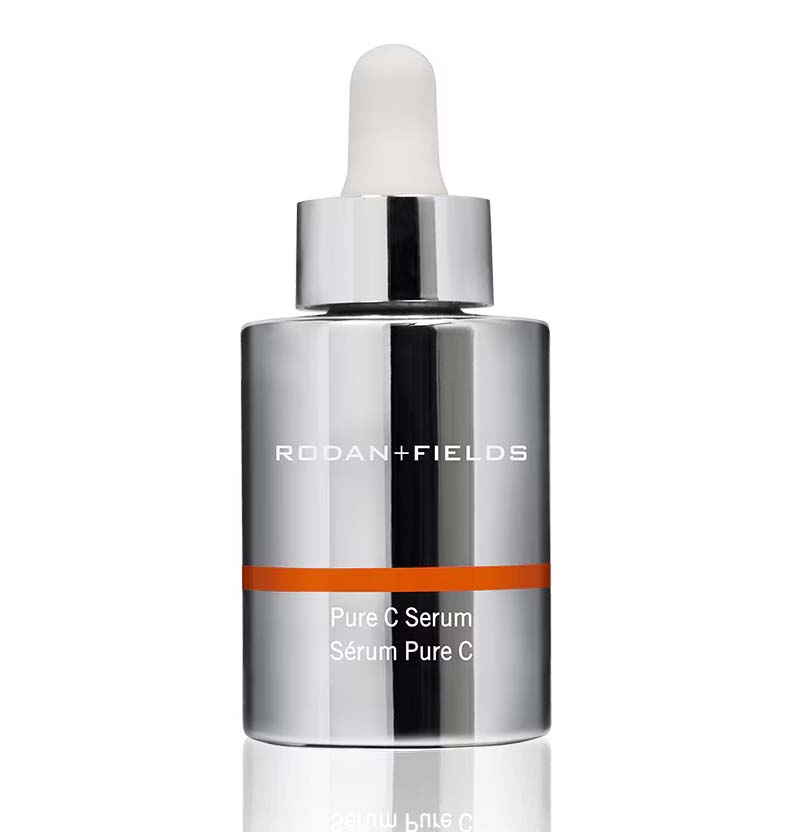
Pure C Serum is a collagen-supporting longevity serum, powered by the purest form of Vitamin C, that helps preserve a youthful appearance for visibly firmer, smoother, brighter skin.
FAQs
Does vitamin C serum really fade dark spots?
Yes, Vitamin C serum may fade the look of dark spots.
How long does it take for vitamin C to visibly improve hyperpigmentation?
In as little as a few weeks, you may see hyperpigmentation visibly improving. Full results tend to take a few months.
Should I use vitamin C serum in the morning or at night for dark spots?
Ideally, you want to use it once in the morning and again at night.
Do I need sunscreen if I use vitamin C serum for pigmentation?
Vitamin C can work in tanden with your sunscreen effects, since it helps to visibly improve discoloration, but it doesn’t protect the skin from the sun. You’ll need to use a sunblock as well.
Can I layer vitamin C serum with other brightening ingredients?
Yes, you can layer it with certain other ingredients, but you’ll want to be careful because you could irritate the skin if you overdo it.
What concentration of vitamin C works best for dark spots?
Research shows 10% to 20% provides optimal results without being too much. If you’re just beginning vitamin C, you may even want to go as low as 5%.